
By Hustlery | Small Business Growth | South Africa
South Africa’s e-commerce market is growing at a pace that would have seemed impossible a decade ago. Online retail revenue is projected to exceed R100 billion by 2027. But here’s the statistic that should shake every South African small business owner: less than 20% of South African SMEs have any meaningful online sales presence.
The others are leaving money on the table. Real, quantifiable, significant money.
Whether you’re selling handmade jewellery in Cape Town, custom clothing from Soweto, organic skincare products in Durban, or professional services in Pretoria – there is a customer searching for exactly what you offer, right now, online. The question is whether they can find you and buy from you.
This guide is for every South African SME that wants to start selling online, sell better online, or build an online revenue stream that works around the clock – even when you’re asleep.
Why Most South African SMEs Aren’t Selling Online (And Why That’s Changing)
The three reasons most South African small businesses give for not selling online:
“It’s too complicated.” Setting up an online store used to require a developer, a designer, a payment gateway integration, and a hosting setup. That’s no longer true. Modern platforms make it drag-and-drop simple.
“My customers aren’t online.” In 2026, this is almost certainly wrong. South Africa has over 45 million internet users. WhatsApp penetration is above 90%. Takealot, Checkers Sixty60, and Woolworths Food delivery have fundamentally changed what South Africans are comfortable buying online. Your customers are online.
“Payment is too complicated in South Africa.” This was true in 2012. Today, PayFast, Paystack, Peach Payments, and Yoco make accepting online payments in Rands straightforward and affordable – with seamless integration into all major platforms.

The barriers are lower than ever. The market is bigger than ever. And the competition among small businesses is less fierce online than most people assume – because so few have gotten there yet.
Step 1: Define Your Online Selling Model
Before you choose a platform, understand which type of online selling makes sense for your business:
Online Store (Product-Based)
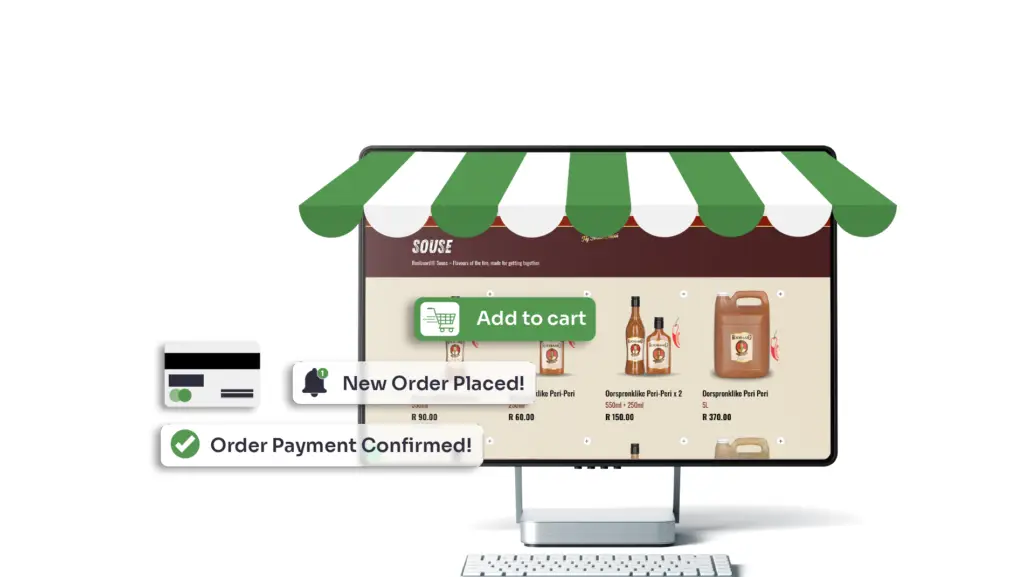
You sell physical or digital products. Customers browse, add to cart, pay, and receive their order.
Best for: Clothing, accessories, skincare, food products, crafts, electronics, gifts, books, digital downloads
Key considerations: Inventory management, shipping, packaging, returns policy
Online Booking / Service Business
You sell time or services. Customers book a session, appointment, or consultation online, pay a deposit or full amount, and attend the session.
Best for: Salons, therapists, consultants, trainers, coaches, tutors, photographers, mechanics, cleaning services
Key considerations: Calendar integration, deposit collection, automated reminders, cancellation policy
Course / Digital Product Business
You create and sell digital content – courses, templates, guides, presets, music, software.
Best for: Educators, coaches, creatives, subject matter experts in any field
Key considerations: Hosting platform, content delivery, licence management
Hybrid: All of the Above
Increasingly, the most successful South African online businesses combine models – a nail technician who sells nail care products, offers online bookings, and runs a beginner nail tech online course. More revenue streams, same audience.
Step 2: Choose the Right Platform for the South African Market
The platform you choose should be optimised for South African payment methods, mobile-first browsing, and ideally have local support.
WooCommerce (WordPress)
Best for: Established businesses that want full control and customisation.
- Highly flexible, unlimited customisation
- Requires some technical knowledge (or a developer)
- Hosting costs R100–R500/month for a decent South African host
- Integrate with PayFast or Paystack directly
SA advantage: Great for established businesses with a web presence already on WordPress.
Shopify
Best for: Product businesses that want something that works fast and looks polished.
- Beautiful themes, easy to use, excellent mobile experience
- Pricing starts at approximately R700/month (USD-based, so Rand fluctuation affects cost)
- PayFast integration available
- Inventory management built in

SA disadvantage: USD pricing means your costs fluctuate with the Rand. No local support team.
Hustlery Website + Funnel Builder
Best for: South African service businesses, coaches, consultants, and SMEs that want an all-in-one solution.
- Build product pages, service booking pages, sales funnels, and landing pages in one platform
- Integrated with PayFast, Paystack, and Stripe – accept Rands directly
- Connected to your CRM – every purchase creates or updates a contact record automatically
- No need for separate email marketing, booking software, or CRM tools
- Rand-based pricing – no USD exchange rate surprises
- South African support team
Best choice for: Any South African business that wants to sell online AND manage marketing, bookings, and client communication in one place.
Facebook/Instagram Shop
Best for: Casual sellers and those just getting started.
- Free to set up
- Leverages existing social following
- Limited customisation and control
- No sophisticated analytics or CRM integration
Good as a starting point or supplementary channel – not ideal as your primary online store.
Takealot Marketplace
Best for: Product businesses with consistent inventory looking for volume.
- Massive built-in traffic – Takealot is SA’s largest e-commerce platform
- High competition and fees (commission + fulfilment)
- Less brand control
- Good for commoditised products, harder for unique/handmade goods
Step 3: The South African Online Customer Experience
Building an online store is not just about listing products and adding a payment button. It’s about creating an experience that converts browsers into buyers – specifically for the South African market.
Mobile First is Non-Negotiable
Over 70% of South African online shopping happens on mobile devices. Your store must be:
- Fully mobile-responsive (not just “works on mobile” but designed for mobile)
- Fast-loading on LTE and 4G (many customers won’t have fibre)
- Easy to navigate with one thumb
- Checkout completable in 3 taps or fewer
Test your store on a mid-range Android phone on mobile data. That’s your median South African customer’s experience.
Payment Options That South Africans Trust
Offering only one payment method at checkout is a conversion killer. South African shoppers want options:
- EFT / Instant EFT – still the preference for many South Africans (PayFast’s Instant EFT is the gold standard)
- Card payment – Visa and Mastercard
- SnapScan / Zapper – popular for lower ticket items
- Buy Now Pay Later – PayJustNow and PayFlex are growing rapidly in SA and significantly increase average order values
The more ways you accept payment, the fewer cart abandonments you’ll have.
Trust Signals Are Critical in SA
South African online shoppers are more cautious than their counterparts in more established e-commerce markets. Fraud concerns are real, and many have had bad experiences. Your store must visibly signal trustworthiness:
- Secure checkout badge (HTTPS, payment provider logos)
- Clear return and refund policy – not buried in terms and conditions, but prominently displayed
- Real customer reviews – with photos where possible
- Physical contact details – a phone number, email, and physical address (or city at minimum) tell customers you’re a real business
- “About” page with faces – customers buy from people. Show your face. Tell your story. It converts.
Step 4: Driving Traffic to Your Online Store
A beautiful online store with no traffic is just an expensive brochure. Here’s how South African SMEs drive online sales:
Social Media → Store
Your social media content should be designed to drive traffic to your store. Every post, every Story, every Reel is an opportunity to move followers from passive viewers to active buyers.
Best practices:
- Show products or services in action (demonstrations, tutorials, before/afters)
- Use the “link in bio” link strategically – update it to your latest offer or featured product
- Use Instagram/Facebook Shopping features to tag products directly in posts
- Stories with “Shop Now” or “Book Here” swipe-up links convert better than posts alone
WhatsApp as a Sales Channel
South Africa’s most underrated e-commerce channel is WhatsApp. Many small businesses complete entire sales cycles via WhatsApp – from enquiry to payment link.
WhatsApp Business features that drive sales:
- Catalogue: Create a product/service catalogue that customers can browse without leaving WhatsApp
- Payment links: Send a PayFast or Paystack link directly in a WhatsApp message
- Status updates: Regular product updates on your WhatsApp Status function like mini-ads to your contact list
- Quick replies: Pre-saved responses for common enquiries (“Price list?”, “How to order?”, “What’s available?”) speed up conversions
Google Shopping and SEO
For product-based businesses, appearing in Google Shopping results (the product images at the top of Google when someone searches for a product) is a major traffic source.
This requires:
- A Google Merchant Center account
- Your product feed connected to Google Ads
- Accurate product titles, descriptions, and pricing
Even without paid Google Shopping ads, investing in basic product SEO – writing detailed product descriptions with keywords South Africans use to search, using alt text on images, and getting your store indexed – generates long-term organic traffic.
Email Marketing for E-Commerce
Your online store customers are your most valuable email subscribers. They’ve already bought from you once – they’re likely to buy again.
Automated e-commerce email sequences to set up immediately:
- Abandoned cart emails: Someone adds to cart but doesn’t complete checkout. An automated reminder 1 hour later (“You left something behind…”) recovers 15–20% of abandoned carts.
- Post-purchase sequence: Thank you email → request for review → cross-sell recommendation → exclusive returning customer offer (30-day sequence)
- Seasonal campaigns: Black Friday, Christmas, New Year, Valentine’s Day, Mother’s Day – these are major e-commerce moments in SA

Step 5: Operations – Delivering on Your Promise
An online sale is only profitable if fulfilment doesn’t eat your margin or destroy your reputation.
Shipping in South Africa
The big three couriers for SMEs: The Courier Guy, Fastway (Aramex), and Courier It. All have competitive rates for small businesses.
Key decisions:
- Offer free shipping above a certain order value (increases average order value significantly – e.g., “Free shipping on orders over R500”)
- Flat-rate shipping is simpler for customers than calculated rates
- Set clear, realistic delivery timeframes – SA couriers can take 1–5 business days depending on location; set expectations correctly
For Joburg-to-Cape Town, door-to-door same-day service exists for premium customers. For standard delivery, 2–3 business days is realistic and expected.
Packaging as Marketing
Your packaging is the first physical brand experience your online customer has. Branded packaging, a handwritten note, a small freebie, or even just excellent presentation can turn a first purchase into a loyal customer and a social media post.
You don’t need expensive packaging to make an impression. Consistency, care, and a personal touch go further than a fancy box.
How Hustlery Powers Your Online Business
Hustlery brings every part of your online sales operation under one roof:
- Website and store builder – drag-and-drop, mobile-optimised, converts visitors to buyers
- Booking system – take appointments and deposits online, synced with your calendar
- Payment integration – PayFast, Paystack, and Stripe built in
- Course and membership builder – sell digital products and online courses
- CRM – every customer, every purchase, every interaction tracked
- Email and SMS marketing – automated sequences, abandoned cart campaigns, post-purchase follow-ups
- AI-powered social media posting – keep your social content feeding traffic to your store
It’s everything a South African online business needs, without stitching together 8 different tools.
Frequently Asked Questions: Selling Online in South Africa
Q: What is the best platform to sell online in South Africa?
A: It depends on your business type. For service businesses and all-in-one simplicity, Hustlery is purpose-built for South Africa. For large product catalogues, WooCommerce offers flexibility. For a quick product store, Shopify is polished and fast. For maximum reach with less brand control, Takealot’s marketplace suits high-volume product businesses.
Q: How do I accept payments online in South Africa?
A: The most trusted local gateways are PayFast (Instant EFT + card), Paystack (card + mobile money), and Peach Payments (enterprise-grade). For in-person and link-based payments, Yoco and SnapScan are popular. Most platforms integrate directly with these – no custom development required.
Q: Do I need to register a business to sell online in South Africa?
A: You can sell as a sole proprietor without formal registration, but registering with CIPC (from as little as R125) provides liability protection and makes you eligible for business banking, which enables better payment gateway options.
Q: How do I handle shipping for an online store in South Africa?
A: The most popular couriers for SMEs are The Courier Guy, Aramex (Fastway), and Courier It. All offer competitive rates and easy integration with major platforms. Set realistic delivery timeframes (2–5 business days for most routes), offer free shipping above a minimum order value, and always provide tracking links.
Q: What is the biggest reason South African online stores fail?
A: Poor mobile experience. Over 70% of SA online shoppers browse and buy on mobile. If your store is slow to load, hard to navigate on a phone, or has a multi-step checkout – you will lose a large proportion of potential buyers before they complete a purchase.
The window to establish an online presence in South Africa before your local competitors do is closing. Not yet closed – but closing.
The businesses that move now – that build their online store, optimise their buying experience, and set up automated marketing to drive and convert traffic – will have a compounding advantage that will be very hard to displace.
You don’t need a developer, a big budget, or a dedicated team. You need the right platform, a clear offer, and the willingness to start.
Your online store is waiting. Hustlery gives you everything you need to build it, sell from it, and grow it – without the agency bill. Start Your Free Trial →